
Coordination, Collaboration and the Arboricultural Pie
- James Isaacs

- Feb 8, 2025
- 8 min read
Updated: May 6
This article was written as an accompanying piece to a talk delivered at the National Arboriculture Conference held at Aotea Centre in late 2024. It expands on the themes discussed in that presentation.
Introduction
Throughout human history, collaboration has been a cornerstone of our greatest achievements. The ability to work together, pool knowledge, and coordinate actions has propelled societies forward, enabling us to overcome complex challenges and achieve success in various domains. This fundamental principle holds particular relevance for the arboriculture industry today.
In a rapidly evolving and increasingly competitive global landscape, the arboriculture sector faces numerous challenges, ranging from skill shortages and market pressures to the need for consistent industry standards. Addressing these issues requires a concerted effort that goes beyond the scope of individual firms, tapping into the collective strength and potential of the wider industry.
This article explores the transformative potential of coordination and collaboration within arboriculture. We will delve into the concept of the "arboricultural pie" as a metaphor for industry value, examine the dynamics of the supply network, and discuss strategic approaches that balance competition with collaboration. Additionally, we will analyse real-life examples and propose actionable strategies to expand the industry's collective value, ensuring a sustainable and prosperous future for all stakeholders.
Industry Value and the Arboricultural Pie?
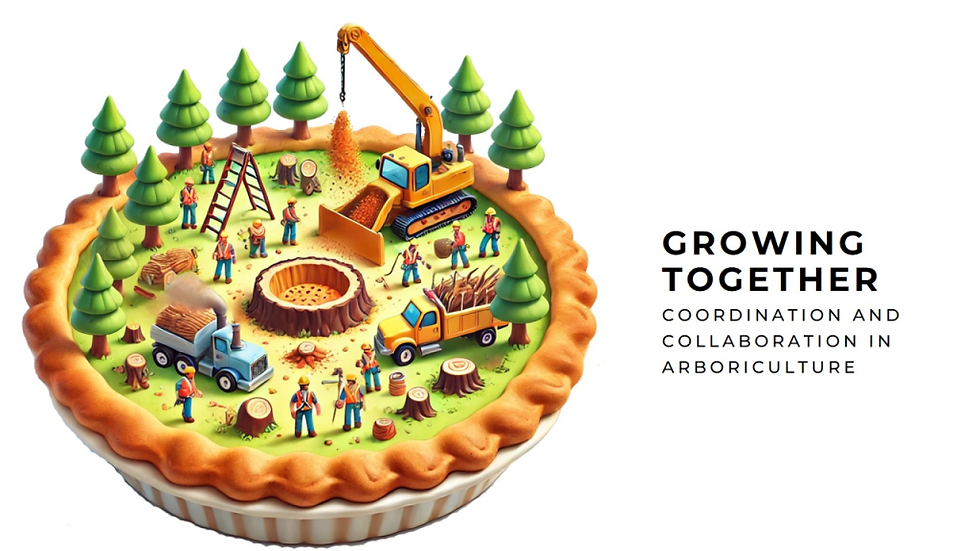
Imagine the arboriculture industry as a giant pie, where each slice represents the value accrued by individual firms and stakeholders. This "arboricultural pie" symbolises the total economic and social benefits extracted from the broader producer network. The central question then becomes: How can we not only secure larger slices for ourselves but also expand the size of the entire pie?
In the context of industry power and coordination, "value" encompasses a wide array of tangible and intangible assets. Tangible value includes direct economic gains such as profits, revenue growth, and cost savings achieved through efficient operations. Intangible value comprises elements like industry reputation, influence over regulatory standards, innovation capacity, employee satisfaction, and environmental impact. Currently, the distribution of this value is often uneven and limited by factors such as fragmented industry practices, skill shortages, and intense competition. Many firms focus on securing a larger share of the existing pie, leading to short-term gains but potentially fostering divisiveness and inefficiency across the industry, and subsequent diminishment of value.
I suggest that a more effective approach lies in collaborative efforts aimed at growing the overall pie. By enhancing coordination and sharing resources, the industry can unlock new opportunities, improve service quality, and address common challenges more effectively. This collective growth mindset not only benefits individual firms through increased profitability and stability but also strengthens the industry's resilience against external pressures such as economic downturns and environmental changes.
Expansion of the pie requires a strategic rethinking of how value is created and distributed. It involves recognizing that collaboration and competition are not mutually exclusive but can coexist to drive innovation and efficiency. In the following sections, we will explore how focusing on collaborative strategies and understanding the dynamics of our supply network can lead to sustainable growth and enhanced industry prosperity.
The arboriculture industry's supply network is a multi-layered system, where each layer—whether it be individual workers, small firms, or larger corporations—plays a crucial role in the overall health of the industry. The focus for both employees and firms should be on fostering growth of their respective layers rather than aggressively seeking to increase their personal share of the existing value. This approach ultimately leads to a larger and more sustainable industry "pie."
Take the case of an individual employee. Here the temptation might be to negotiate for a larger personal share of the firm's success, such as higher wages or more favourable terms. If successful this might prove beneficial in the short-term, but it can inadvertently reduce the firm's overall potential, with such demands often meeting resistance from owners and other stakeholders whose share is being diminished. By instead focusing on contributing to the growth and success of the firm—through skill development, improving efficiency, or enhancing service quality—employees can help expand the firm's value. This expansion not only grows the overall pie but also positions the employee to receive a larger slice, both because the pie is bigger and because those who contribute to its growth are often seen as deserving of a larger share.
Similarly, at the firm level, focusing on growing the industry rather than just the individual firm can yield even greater benefits. When firms invest in industry-wide initiatives, such as developing standardised practices, improving training programs, or advocating for favourable regulations, they contribute to a healthier and more robust industry. This, in turn, reduces resistance from competitors and regulators, as the collective success of the industry benefits all players involved. By promoting industry growth, firms can secure a larger slice of an expanding pie, benefiting from increased demand, better market conditions, and stronger collaborative networks. This not only leads to a more supportive and sustainable industrial environment but also enhances the firm's own stability and growth potential, ensuring a more prosperous future for everyone involved.
Coordination in action
Historical and contemporary examples illustrate the potential impact of coordinated action and collaboration within industries, particularly through the lens of labour unions. In New Zealand, labour unions once wielded significant power by effectively coordinating the actions of workers. This coordination enabled them to secure better wages, improve working conditions, and bolster employee rights. The unions' strength came from their ability to present a united front with the capacity to deliver considerable force upon employers who did not comply with their demandes. This collective power allowed unions to negotiate terms that individual workers could never achieve alone.
However, with great power comes great responsibility, and the unions eventually overreached. By pushing wages and conditions beyond what the market could sustainably bear, they inadvertently set the stage for their own downfall. Rather than striving for a market-clearing wage—a level where the supply of labour meets demand without surplus or shortage—they pursued maximal gains. This approach led to inefficiencies, as the cost of labour began to exceed what the market could support, ultimately shrinking the overall economic "pie" rather than growing it. The reaction came swiftly in the form of the neoliberal reforms of the 1980s, which were designed, in part, to curb the power of unions by preventing workers from coordinating their actions as effectively. The result was a dramatic reduction in workers' collective power, leading to wage stagnation, job insecurity, and a decline in working conditions that still affects many industries today.
In contrast, countries like Germany, which operate under coordinated market economies, offer a compelling example of how unions can sustain their influence by focusing on the broader economic good. In these systems, unions, employer associations, and the state work together as part of a tripartite governance structure. German unions, aware of the delicate balance between wages and the global competitiveness of German goods, aim to find the most efficient wage level—one that supports workers while maintaining the industry's international demand. By avoiding the trap of endless confrontation and instead pursuing balanced, market-aligned outcomes, these unions have maintained their relevance and power.
The lesson here is that coordination is a very powerful tool, but it must be aligned with the overall market needs to be truly sustainable. Establishing and strengthening collaborative mechanisms—whether through enhancement of industry associations, standardisation of processes, or sector-wide agreements—can yield significant benefits. Such actions not only enhance resilience and efficiency but also ensure that the industry grows the pie for everyone involved, rather than diminishing it through short-sighted pursuits of individual gain.
Growing the Arboricultural Pie
Expanding the arboricultural pie involves both increasing the industry's overall value and ensuring its equitable distribution among stakeholders. A key strategy for achieving this growth is the development and implementation of minimum industry standards (MIS). These standards cover elements such as safety protocols, technical competencies, environmental practices, and ethical guidelines. The New Zealand Arboricultural Association, in collaboration with Arboriculture Australia, has already made significant progress in creating these standards. However, much work remains to be done, namely, promoting the adoption and integration of these standards across the industry.
To enhance access and adherence to these standards, the adoption of advanced technology, such as GPT (Generative Pre-trained Transformer) models, presents a promising opportunity. These models have been successfully implemented in various industries to streamline access to critical documents and ensure that professionals stay current with evolving standards and best practices. For example, the American Society of Civil Engineers (ASCE) uses a domain-specific language model to help members quickly access technical documents, while the Institute of Food Technologists (IFT) employs a custom model to simplify searches through extensive research libraries.
In arboriculture, a model like this could serve as a comprehensive repository for all Minimum Industry Standards (MIS) guides, codes of practice, and relevant legislation. This powerful tool would allow users to query all these resources simultaneously, ensuring quick and accurate access to critical information. The system could be used for the rapid creation and maintenance of up-to-date training materials that align with the latest MIS. Individual firms could leverage the model to generate Standard Operating Procedures (SOPs), policies, and other essential documents that consistently reflect current best practices. Moreover, the model could offer immediate, accurate guidance on a wide range of arboricultural queries, helping to bridge the skill gap and improve overall consistency within the industry.
As a practical example, the production of this article was supported by a similar model, the freely available Arb Skill Shortages GPT, which I created to help ensure my writing aligns with the research I have previously conducted as well as being useful for general queries regarding skill shortages in arboriculture. Developing a working prototype for the MIS version of the system described here would be a surprisingly straightforward process, resulting in a powerful shared resource to drive coordination and operational efficiency.
Challenges and Considerations
While the benefits of enhanced collaboration are clear, implementing such strategies within the arboriculture industry presents several challenges that must be thoughtfully addressed. One significant obstacle is the inherent diversity within the industry, encompassing a wide range of firm sizes, operational models, and regional contexts. Aligning the interests and priorities of small independent operators with larger corporations requires sensitive negotiation and inclusive policy-making. Ensuring that collaborative initiatives are designed to benefit all stakeholders, regardless of scale, is essential for widespread adoption and sustained cooperation.
Another challenge lies in overcoming entrenched competitive mindsets and fostering a culture that values collective success alongside individual achievement. This shift necessitates effective communication of the long-term benefits of collaboration, including stability, increased market opportunities, and the creation of shared resources. Industry leaders and associations play a pivotal role in championing this cultural transformation through advocacy, education, and role modelling.
Summary
In summary, the arboriculture industry stands at a critical point where embracing collaboration can unlock significant potential for resilience and growth. By focusing on strategies that promote the development and adoption of Minimum Industry Standards (MIS), leveraging advanced technology like GPT models, and encouraging cooperative efforts across all levels of the industry, we can significantly expand the collective value—the arboricultural pie.
Shifting from a predominantly competitive approach to one that emphasises strategic collaboration allows the industry to tackle key challenges, such as skill shortages and the need for consistent standards. This collaborative mindset not only enhances the performance of individual firms but also strengthens the industry's overall stability, market conditions, and capacity for innovation.
Realising this vision will require dedication and active participation from all industry stakeholders, including firms of all sizes, industry associations, educational institutions, and government bodies. Through sustained collaboration, shared resources, and collective action, the arboriculture industry can build a stronger, more unified community, ensuring a prosperous and sustainable future.
The call to action is clear: Let us harness our collective strength, pool our knowledge, and coordinate our efforts to cultivate a thriving and dynamic industry that serves the needs of today while planting the seeds for a prosperous tomorrow.


Comments