
Intent-Aligned Marketing
- James Isaacs

- Jan 1
- 5 min read
Updated: May 6
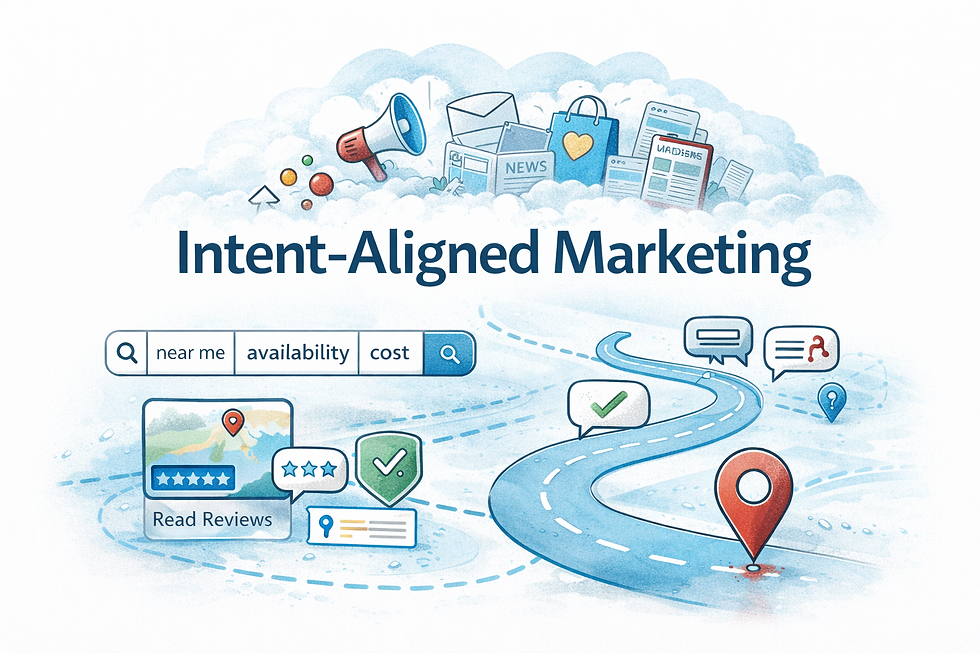
Many marketing efforts fail at the point where a decision should happen. People are already looking and comparing options, already trying to decide, yet enquiries feel inconsistent, conversions feel fragile, and marketing effort feels heavier than it should. Activity increases, dashboards look busy, and still the sense remains that something fundamental is not working as it should. The usual diagnosis is a lack of awareness, and the usual response is to produce more content, run more campaigns, and push more messages into the market. That diagnosis is often wrong.
Often, the issue is not that people are unaware, uninterested, or unconvinced. It is that when demand is actively expressed, the business is not sufficiently clear, credible, or easy to choose. The problem sits closer to the moment of decision than the moment of discovery.
This is where intent-aligned marketing begins.
Intent as a distinct concept
Most marketing thinking revolves around interest, how to generate it, nurture it, and convert it over time. This approach makes sense in discretionary markets, where demand needs to be created, shaped, and sustained. It also makes sense when decisions are slow, optional, or exploratory.
In many service categories, however, demand already exists. People are not browsing casually or collecting inspiration. They are attempting to resolve a problem, often within a narrow window of time, and often with limited tolerance for friction or ambiguity. In these situations, interest is not the binding constraint, intent is.
Intent is not curiosity, it is not awareness, and it is not engagement. Intent is behavioural. It appears when someone searches with constraints such as location, availability, or cost, when they compare reviews rather than read articles, when they look for reassurance rather than inspiration, and when they want to know what happens next rather than learn more. These moments are short, local, and unforgiving. If the information they encounter does not resolve uncertainty quickly, the decision moves elsewhere, usually without any signal that it ever passed by.
This is why businesses can feel invisible even when demand is strong. The demand is present, but it is not being captured.
Why awareness-first thinking breaks down
Awareness-first marketing assumes a managed sequence, attention leading to engagement, engagement to consideration, and consideration to action. This model implies that businesses can guide people gradually through a linear journey, warming them up and increasing commitment step-by-step.
In practice, many real-world decisions do not behave this way. When something becomes urgent, breaks, or needs resolving, people do not want a journey, they want resolution. They scan, assess, and decide, often in minutes, sometimes in seconds. In these contexts, additional content, personality, or storytelling rarely helps. It anything, it can actively get in the way.
When someone is trying to decide, their primary need is interpretability. They want to understand what you do, whether it applies to their situation, whether you appear competent and trustworthy, and what the next step involves. If those answers are not immediately obvious, awareness offers little value. Familiarity without clarity does not reduce risk. It increases hesitation.
This is one of the quiet failures of awareness-led strategies in need-driven markets. They optimise for attention when the real requirement is confidence.
Interest versus intent
The distinction between interest and intent is subtle but critical. Interest is emotional. Intent is behavioural. Interest asks whether something is appealing or engaging. Intent asks whether something will work and whether it can be trusted.
Behavioural decisions are sensitive to small failures that are easy to overlook. Unclear service boundaries, weak or missing social proof, outdated information, slow response times, unnecessary steps, and contradictory signals all increase cognitive load at precisely the moment when people are least willing to tolerate it. None of these failures look dramatic in isolation. Together, they quietly erode conversion and create the impression that demand is weaker than it actually is.
This is why intent-aligned marketing places such emphasis on clarity, consistency, and routing. It treats marketing less as persuasion and more as decision support.
Funnels, volume, and misplaced optimisation
Traditional marketing funnels optimise for volume. The underlying assumption is that inefficiency at the bottom can be compensated for by widening the top. If more people enter the system, enough will eventually convert.
In intent-driven markets, this logic often backfires. Demand already arrives, unevenly, at different stages of readiness, and often much closer to action than awareness models assume. Adding more volume does not resolve friction. It competes with high-intent demand for attention, response capacity, and operational focus. Low-intent traffic creates noise that slows response times, dilutes clarity, and increases internal load. In these contexts, the constraint is not exposure, it is throughput.
Throughput describes how efficiently a system converts existing inflow into outcomes. When throughput is low, pouring more in does not help. It creates turbulence. It increases spillage. It makes the system harder to manage. This is why many operators experience a paradoxical effect; more marketing activity coinciding with worse results.
This is why the intent-aligned position is not to widen funnels, but to increase throughput.
Marketing as flow management
Once marketing is understood as a flow problem rather than an awareness problem, the role of marketing changes. The task is no longer to attract as many people as possible, but to ensure that when the right people arrive, nothing blocks them from deciding.
This reframes marketing as infrastructure rather than promotion. The focus shifts to whether signals are readable, whether reassurance is easy to find, whether response paths are obvious, and whether the next step is frictionless. The work becomes quieter and more structural, but also more durable.
The corrective move is not to eliminate awareness entirely, but to demote it from centre stage. For need-driven businesses, the strategic priority is not to be broadly known, but to be obvious at the moment of intent. This means being discoverable where problems are actively expressed, communicating competence quickly and plainly, reducing friction rather than increasing engagement, and making reassurance easier to find than personality.
When these conditions are met, awareness emerges naturally. People remember you because you helped them decide, not because you entertained them.
What intent-aligned marketing looks like
Intent-aligned marketing often feels underwhelming on the surface. There are no big launches, no constant publishing schedules, no dramatic campaigns designed to capture attention. Instead, there are cleaner signals, fewer but better enquiries, shorter decision cycles, and less pressure to manufacture activity. Success is quieter, but more decisive. Conversations improve, enquiries are clearer, internal effort drops, and marketing efforts feel less abstract.
This is why intent-aligned work often feels closer to systems design than promotion. The goal is not to create demand, but to remove the obstacles that prevent existing demand from converting.
A different measure of effectiveness
When marketing is aligned to intent, the usual metrics lose importance. The question is no longer how many people saw something, how much engagement it generated, or how wide the funnel appears at the top. The question becomes whether it made it easier for the right people to decide, whether it reduced hesitation, and whether it clarified the next step.
When those answers are yes, demand flows with less effort, not because it was manufactured, but because it was no longer blocked.
That is the core of intent-aligned marketing!


Comments