
Survival vs Selection Mode: Why Being Busy Can Still Be the Problem
- James Isaacs

- Jan 15
- 5 min read
Updated: May 6
Many service businesses are busy again. Phones are ringing, crews are out working, and diaries look full. In stark contrast to just a few months ago, demand appears to have returned. Yet despite this apparent recovery, a common sentiment persists among owners: margins remain thin, stress is high, and the work itself feels harder than it used to.
This disconnect is often attributed to external factors such as tougher customers, lingering economic uncertainty, or rising costs. While those pressures are real, they frequently mask a more fundamental issue. The business is still operating in survival mode, even though the environment no longer requires it.
Survival mode and selection mode: Two operating states
Most service businesses move between two distinct operating modes, often without naming them.
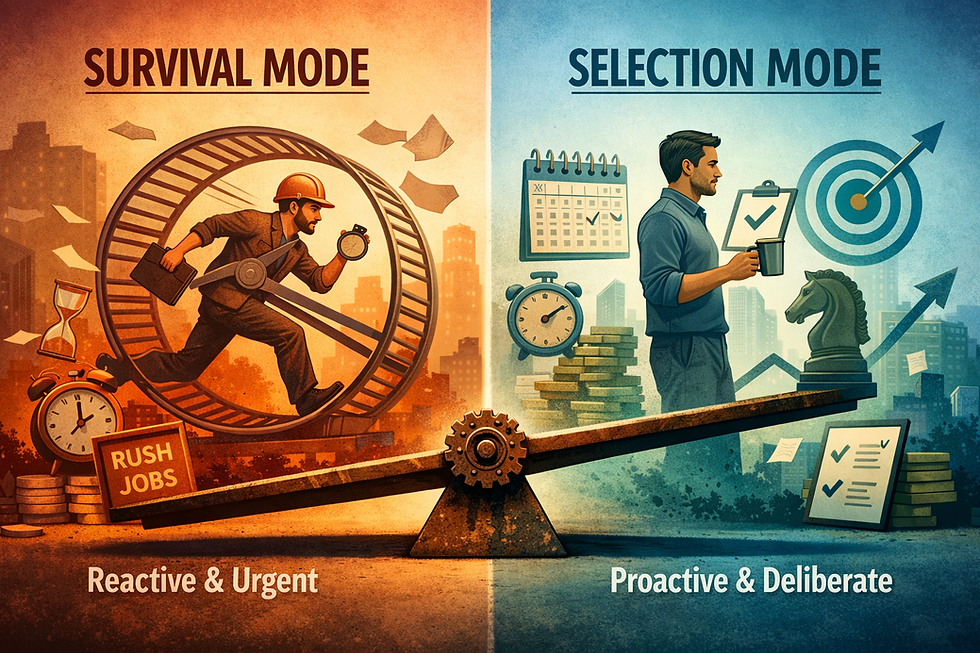
Survival mode emerges when work is uncertain. The priority becomes keeping people busy and maintaining cashflow. Decisions optimise for speed, urgency, and volume. Filters loosen, and work that would not normally be prioritised is tolerated because the alternative feels worse.
Selection mode, by contrast, is the ability to choose work deliberately rather than reactively. It depends on having some buffer in the system—not excess, but enough breathing room that decisions are not made with the business under immediate pressure. In this mode, fit matters, time-quality matters, and margin matters.
Both modes are rational responses to different conditions. The problem is not entering survival mode when demand drops. The problem is forgetting to leave it once conditions change.
Why survival mode lingers after downturns
When demand falls, survival mode is adaptive. It keeps businesses alive. What is less obvious is how long survival logic can persist after the environment improves.
Demand rarely returns evenly. Early enquiries during a recovery tend to be urgent, price-driven, or emotionally charged. Systems built during scarcity—advertising campaigns, quoting processes, intake rules—continue to reward speed and volume because that is what once worked. Psychologically, owners also tend to overweight the memory of empty pipelines and idle crews, even when those risks have receded.
The result is a form of mode lag. The environment changes, but the business does not recalibrate. Survival mode quietly becomes the default. While the ramifications extend far beyond marketing, marketing is often where the effects first become visible.
Time horizon collapse and reactive marketing
One of the deepest drivers of survival mode is not strategy, but time perception. This pattern does not require an economic downturn to appear. Many operators leave marketing until the diary is empty. While work is flowing, there is no perceived urgency to maintain it. When work suddenly runs out, the planning horizon collapses. At that point, only tactics that work immediately can be considered.
Marketing is forced into a reactive posture. Long lead-time activities are no longer viable. What remains are urgent, fast-acting signals designed to fill the diary quickly. The business does not consciously choose survival mode; it arrives there because the future has shrunk into the present.
This dynamic is especially common in trades and service businesses, where demand is lumpy, work is physical, and cognitive load is high. Over time, reactive marketing stops being a tactic and becomes a stress response.
How urgency starts selecting customers for you
Urgency often looks like demand, but it is a very specific kind of demand. When a business signals speed, availability, and immediacy, it not only attracts people who genuinely need fast help, but also people whose behavioural style is "urgent": Control-oriented, low in tolerance for uncertainty, and highly demanding around timing and outcomes.
These customers are not inherently “bad”, but they tend to consume disproportionate amounts of time and energy. More importantly, urgency fragments time. Rushed decisions, compressed estimates, and rigid scheduling demands do not just affect the job in question; they degrade everything around them. One poorly aligned piece of work spills stress and inefficiency into the next several decisions.
Over time, calendars fill while decision-quality drops. The business appears busy while quietly losing the conditions that once supported good judgement.
Why survival work attracts the most competition
A second effect often goes unnoticed: Survival-mode work is where competition concentrates.
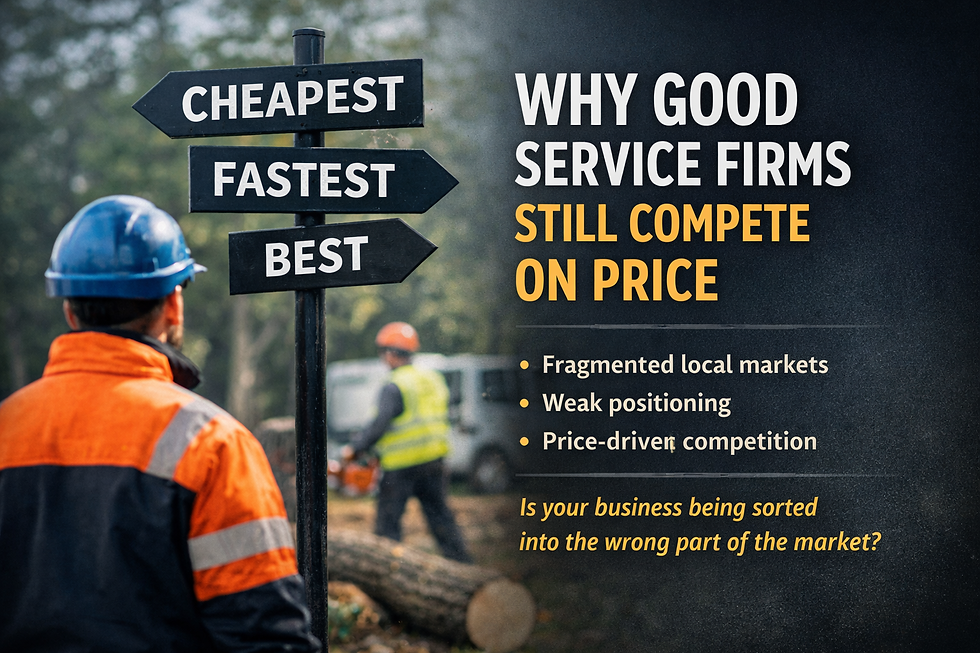
During and after downturns, most companies chase the same urgent, low-friction work. Advertising clusters there, prices are pushed down, and differentiation collapses. Ironically, the work that feels safest to pursue is often the most crowded and least profitable.
Better-fit work tends to return more slowly and requires confidence to wait for. Businesses that switch back to selection mode earlier often find that competition thins out higher up the quality curve—not because demand is lower, but because fewer operators are positioned to receive it.
Google Ads as a selection engine, not just a lead machine
This dynamic becomes particularly clear in paid advertising. Google Ads does not simply generate leads, rather it selects customers based on what the system is optimised for. When campaigns are tuned for conversion volume and low cost, the algorithm learns to favour people who convert quickly and cheaply. These users are often impulsive, price-sensitive, and highly reactive to advertising.
That does not make the data wrong, it makes it incomplete. When businesses optimise primarily for cost per lead, they disproportionately attract the segment that is cheapest to convert rather than the segment that is best to serve. If this optimisation is established during survival mode and never unwound, the business continues feeding itself customers that reinforce urgency, margin pressure, and time fragmentation.
Importantly, this is not a Google-specific problem. The same effect occurs without advertising whenever businesses remove qualifiers, simplify promises, or chase volume under pressure. Direct-response systems reward speed and compliance, not fit.
Why more work can still make things worse
At this point, many owners push back. More work, after all, is always better than less work. In absolute terms, that is probably true. However, in a capacity-constrained system, it is also incomplete.
Time is finite. Low-margin, high-friction work does not merely add revenue, rather it displaces better work. The cost of this displacement is largely invisible. It appears as opportunities that were never quoted properly, higher-value enquiries that could not be accommodated, or decisions that were rushed under pressure.
This is how businesses end up with full diaries, tired crews, and flat profits. They remain busy in survival mode long after survival has ceased to be the core problem.
Why selection mode cannot be switched on overnight
Selection mode is not a mindset shift that happens on a Monday morning. It is a condition that is maintained over time. It depends on consistent, low-stress marketing carried out when things feel stable rather than urgent; buffers that prevent panic from driving decisions; systems that tolerate slightly lower volume in exchange for better fit; and recognising when survival logic has outlived its usefulness.
The risk is not that a business ever enters survival mode, rather that this mode becomes the permanent default.
The question worth asking
Many service businesses survived the recent downturn. Far fewer have consciously exited it. If work is available but the business still feels brittle, it is worth asking whether the systems making decisions today are still optimised for scarcity. Not because those systems were wrong, but because the world they were built for may no longer exist.
Sometimes the most important shift is not getting more work, but restoring the ability to choose it.

Comments