
From Labour Shortages to Market Signals
- James Isaacs

- Feb 9
- 8 min read
Updated: May 6

Why marketing became the upstream lever
For a long time, my work focused on labour shortages in arboriculture and other service industries. More recently, that focus has shifted toward marketing. From the outside, this can look like a change in direction. In reality, it reflects a necessary transition driven by the same underlying problem, examined from a different point in the system.
This article traces that transition. It explains why labour initially appeared to be the binding constraint, why that explanation proved insufficient on its own, and how marketing came to be understood not as a replacement concern, but as one of the few upstream levers through which those same coordination problems could be addressed more effectively.
Why struggling service businesses misdiagnose the problem
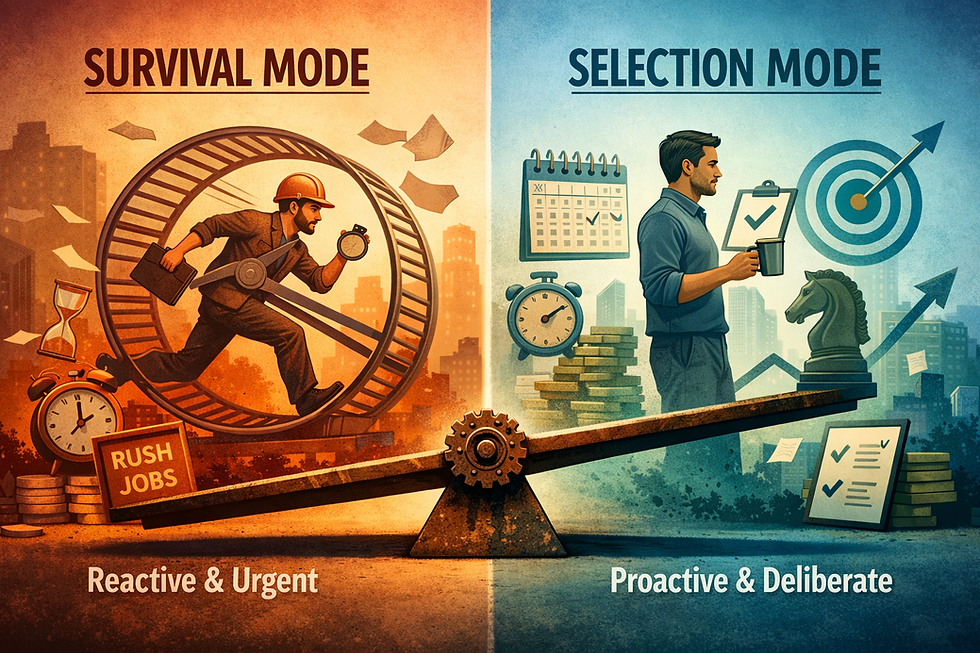
When service businesses begin to struggle, the response is rarely inactivity. Attention narrows toward what can be acted on immediately: securing the next job, keeping crews working, maintaining cash flow, and limiting exposure to further downside. Decisions become shorter-term as longer-range planning starts to feel like a luxury the business can no longer afford.
In that state, businesses gravitate toward adjustments that promise quick relief. Marketing activity is intensified or diversified in the hope of smoothing work intake, operational throughput is pushed harder to compensate for uncertainty, and risk is managed by becoming more reactive rather than more selective. Effort increases, but it is increasingly directed toward keeping the system moving rather than understanding where it is misfiring.
Over time, a familiar pattern emerges. The business remains busy, sometimes uncomfortably so, yet lacks confidence about what lies ahead. Work arrives unevenly, enquiry quality varies, and planning horizons shrink. The organisation is active and visible, but decisions are made defensively, with limited capacity to step back and reconfigure how demand is being shaped or filtered.
What became apparent through operating experience and later client work was that the issue was not effort, nor even demand in the abstract. It was the conditions under which decisions were being made. When a business is locked into continual short-term response, it loses the ability to influence how demand enters the system, instead adapting around whatever arrives. In that context, additional activity rarely produces stability. More often, it amplifies variability, increasing noise while leaving the underlying coordination problem untouched.
Why marketing amplifies problems instead of fixing them
Once decision-making compresses around the immediate, marketing is often pulled into service as a corrective tool. Activity is increased, channels are added, and messages are adjusted in the hope that more visibility or persuasion will compensate for instability elsewhere. The assumption, usually implicit, is that marketing can repair underlying weakness through volume.
In practice, marketing does something more limited and more consequential. It amplifies and distributes the signals a business is already sending. It shapes how the firm is interpreted, how risk is perceived, and how choices are framed at the moment of decision. Where those signals are coherent — for example, where a business can be understood, trusted, and distinguished — marketing can be highly effective. Where they are not, additional activity tends to make the problem louder rather than clearer.
This is particularly acute in competitive service markets. Increased visibility does little to resolve ambiguity, and persuasion cannot reliably substitute for trust. As activity rises, attention may follow; however, clarity often does not. The result is frequently higher churn, fragile conversion, and greater operational strain, rather than the stability the business is seeking.
Seen this way, the question shifts. It is no longer whether more demand can be generated in the abstract, but whether existing demand can be shaped into a form the business can reliably serve and sustain. Until that is addressed, marketing effort remains reactive and the coordination problem persists.
Competition without coordination in fragmented industries
The arboriculture sector is a useful example because it exposes these dynamics clearly, although it is far from unique. It is a relatively young, fragmented industry with low barriers to entry and intense competition. During my time working in the sector, I observed skilled operators regularly breaking away from their employers to work for themselves, increasing fragmentation and compounding existing workforce constraints. From the customer’s perspective, this translated into an expanding field of providers who appeared broadly similar and difficult to distinguish.
In response, service quality and responsiveness at the customer interface often deteriorated, not through indifference but through necessity. Smaller operators frequently delivered competent technical work yet struggled with quoting, follow-up, and continuity as administrative demands competed with time in the field. Larger firms invested in structure and reliability, however those same investments introduced overheads that left them vulnerable as conditions shifted. By the time a decision needed to be made, customers were not lacking options so much as struggling to interpret them.
Within that environment, trust and clarity — rather than awareness — became the binding constraint. The firms that endured were not always those with the strongest technical capability, rather those able to communicate who they were, reduce perceived risk, and demonstrate a willingness to stand behind their work when outcomes fell short. Over time, those signals mattered more than volume, visibility, or breadth of offering.
What demand and trust look like under uncertainty
The implications extend well beyond arboriculture. In many service industries, the problem customers face is not a lack of options, but the difficulty of choosing between them with confidence. When signals are weak or inconsistent, uncertainty is pushed outward onto the customer, who must absorb the risk of making the wrong choice. Decision-making slows, fragments, or defaults to blunt shortcuts, not because customers are disengaged, but because the cost of being wrong feels asymmetric.
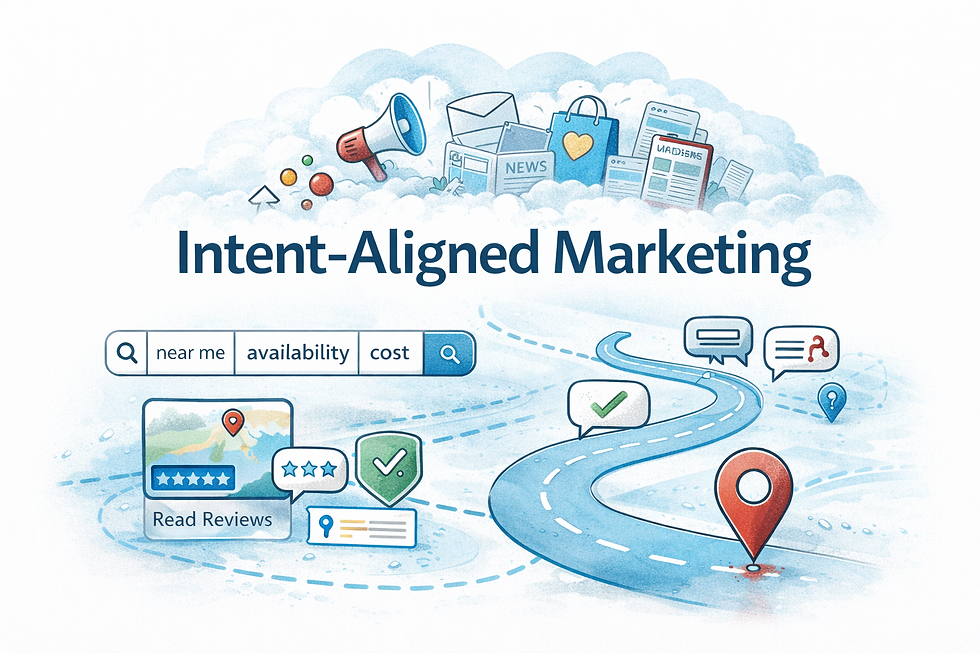
In those conditions, trust cannot be treated as something that emerges after contact has been made. It must be established earlier, through signals that reduce ambiguity before an enquiry is submitted. Clarity around scope, reliability, and accountability begins to matter more than novelty or reach. Where that clarity is absent, genuine demand can exist without reliably turning into action.
This helps explain why marketing so often disappoints when approached primarily as promotion. The constraint does not sit at discovery, but at selection. Until that distinction is recognised, effort tends to be directed toward making businesses more visible rather than more legible.
From labour economics to market signalling
When I first tried to understand what was limiting outcomes during my time in arboriculture, labour appeared to be the binding constraint, not as an abstract economic issue but as a practical one experienced daily inside operating businesses.
The logic was straightforward. You could not do sufficient work without enough people, you could not consistently do good work without skilled people, and you could not credibly market quality if delivery itself was unreliable (because of your people). Across firms of very different sizes and structures, conversations about growth, stress, or decline repeatedly converged on the same issue: attracting, retaining, and coordinating capable staff was shaping what the business could realistically achieve.
Because this constraint appeared so persistent — and because similar complaints surfaced across multiple service industries — labour economics offered a useful lens. If skills were scarce, then understanding how they were priced, developed, retained, and allocated should help explain why performance remained fragile even where customer need was obvious. The assumption was that resolving the skill shortage would relieve pressure elsewhere in the system.
The research led to a conclusion that was simple in principle but difficult in practice. Skill shortages are not inherently mysterious. Where wages and conditions improve, labour supply generally responds. However, individual firms are rarely free to make such adjustments in isolation.
Wages sit downstream of prices, and prices sit downstream of the product market. In fragmented, highly competitive markets with weak differentiation, firms struggle to raise prices in ways that are both defensible and durable. Attempts to improve wages without improving prices tend to be short-lived, while attempts to improve prices without credible differentiation tend to fail.
At that point, the labour problem ceases to be a labour problem in isolation. Firms are constrained not because skilled workers are unavailable, but because the market makes it difficult to pay for them. Competitive pressure compresses margins and leaves little room for investment in training, supervision, or resilience. Each response is locally rational; taken together, they produce a system that struggles to improve.
What became clear is that labour markets and product markets are tightly coupled. Improving wages requires prices that can be held. Holding prices requires customers to distinguish between alternatives and accept trade-offs. And that depends on how firms are signalled, interpreted, and selected at the point of decision.
Why the leverage moved upstream
Once this coupling became clear, the question stopped being whether labour mattered and became where intervention was most likely to have leverage.
If wages could not improve without prices rising, and prices could not rise without customers accepting differentiation, then the bottleneck was no longer inside the firm. It sat at the interface between the business and the market, at the point where customers interpreted options and decided who to trust. The problem had shifted from production to selection.
For a long time, I assumed that resolving this required explicit market coordination. In more established industries, prices often move through shared norms or institutional structures. In fragmented service markets, explicit coordination is both constrained and risky. Direct price coordination is illegal, and collaboration around labour conditions proved difficult to sustain at scale.
Marketing presented a different set of incentives. Improvements in how a firm establishes trust, clarifies its offer, and communicates accountability can generate immediate firm-level returns, while indirectly rewarding better practices by pulling demand toward operators who can credibly justify higher prices. In that sense, marketing operates as a form of implicit coordination — not through agreement, but through selection.
Where marketing sits in a functioning business
Seen through this lens, it becomes useful to be explicit about where marketing sits within a functioning business.
A service business operates across several interdependent layers. At the most concrete level sits delivery: the work itself. Above that sit culture, capability development, leadership, and longer-term strategy. These layers matter enormously, but they are resource-intensive and fragile under sustained pressure.
Marketing sits earlier. It is the mechanism through which work enters the system, shaping not only how much demand arrives but what form it takes and how predictable it is. Before a business can invest meaningfully in higher-order improvements, it must first secure demand that is consistent, interpretable, and defensible.
Treating marketing as interchangeable with promotion obscures its role in the causal chain. Visibility alone does little to reduce ambiguity or perceived risk. In competitive service markets, the primary function of marketing is to help customers make sense of their options and choose with confidence.
Why Ostix is designed this way
Once marketing is understood as an upstream constraint rather than a downstream activity, the design of Ostix becomes less a matter of preference and more a matter of necessity.
If the problem is not effort but clarity at the point where demand is interpreted and directed, then acting immediately through tactics risks amplifying exactly the wrong signals. In that context, diagnosis is not a preliminary step to optimisation; it is the actual work.
Ostix begins with analysis rather than execution to understand how demand is actually arriving, how decisions are being made, and where ambiguity or mistrust is introduced. Only then does it become possible to judge what is worth fixing now, what can wait, and what should be left alone.
This is not a departure from earlier work on labour and coordination. It is a continuation of it, applied at a point in the system where individual firms can act, observe results, and adjust without requiring collective agreement or prolonged exposure to risk.
A necessary transition
This shift from labour shortages to market signals reflects a judgement about leverage, not a change in values. The coordination failures remain, but the point at which they can be addressed most plausibly has moved upstream.
Although arboriculture features heavily in this discussion, it functions here as an illustrative case rather than a defining one. The dynamics described — fragmented competition, weak differentiation, compressed decision-making, and difficulty holding prices despite real demand — recur across a wide range of local and service-based industries. Trades, professional services, healthcare, childcare, equipment hire, and many owner-operated businesses exhibit similar patterns, even where the surface details differ.
The conclusions drawn are therefore not sector-specific. They reflect a broader class of coordination problems that emerge wherever markets struggle to distinguish between providers and where trust must be established before work can reliably flow.
If trust and clarity cannot be established at the moment of choice, nothing downstream holds for long. Better questions must come before more effort.

Comments