
Recruiting Skilled Arborists Starts Before the Job Advertisement

Experienced arborists do not evaluate a vacancy in isolation. They compare the complete employment arrangement with remaining where they are, joining another employer, working as a contractor, starting a business or eventually leaving arboriculture altogether.
When an arboriculture employer struggles to recruit, the problem becomes visible at the point where a vacancy is advertised. The job receives few suitable applications, experienced candidates fail to respond or promising conversations do not progress into accepted offers. This can make recruitment communication appear to be the primary constraint.
The advertisement, however, is near the end of a much longer process. Before it is written, the organisation has largely already determined how the work will be planned, what the employee will be paid, how their skills will be used, which crew they will join, how much authority they will hold, what physical demands they will face and what kind of future the position might lead to.
The advertisement can describe these conditions, obscure them or exaggerate them. It cannot create better conditions where they do not exist.
For employers seeking experienced climbers, crew leaders and other scarce operational staff, the more useful starting question is therefore not how to make the vacancy sound more attractive. It is what would need to be true inside the organisation for a capable arborist to prefer this employment over the realistic alternatives available to them.
The advertisement is often written for several different candidates
Arboriculture employers usually remain open to the possibility that an unusually strong candidate might appear. This person may be highly experienced, still physically capable, commercially useful, able to lead a crew, hold the required licences and, for some reason, be actively looking for another job.
Such candidates do occasionally enter the market. They may have moved to a new area, returned from overseas or encountered a legitimate reason to leave an otherwise satisfactory position. Their availability can also indicate problems that are less visible during recruitment. A convincing work history may conceal reliability, conduct or personal difficulties that only become apparent after employment begins.
Because the rare candidate might exist, advertisements often display a wide pay range and describe an ambitious collection of preferred capabilities. The upper end may be available for someone who can immediately lead a productive crew, complete advanced work and operate with limited support.
The same advertisement may then make clear that the employer will consider someone with only limited industry experience. Heavy-vehicle licences, specialist equipment capability and other useful attributes are described as advantages, even where the company has not decided how much more it is prepared to pay for them.
This produces a vacancy that is partly a search for an advanced arborist, partly a search for a developing worker and partly an invitation for anyone with enough exposure to be worth meeting.
There is a practical reason for keeping the field open. The employer cannot control who happens to be available when the vacancy is advertised. However, a very broad advertisement can conceal uncertainty about what the organisation actually requires.
The company may need an independent crew leader but be prepared to hire a developing climber because the stronger candidate is unlikely to appear. It may advertise the wage available to the rare candidate while most realistic applicants would enter near the bottom of the range. It may list several valuable supporting capabilities without understanding which of them would create enough operational value to justify different terms.
The recruitment problem is then wider than a shortage of applicants. The organisation has not yet defined which capability is constraining it, what that capability would enable and how the role should change according to the person hired.
Experienced arborists are rarely choosing between advertisements
Someone entering arboriculture may actively search for a first opportunity. They need an employer willing to take them on, expose them to useful work and begin developing their capability.
At this stage, there may be little on paper that distinguishes the applicant from many other people seeking entry into practical work. They may possess enthusiasm, physical ability or a relevant licence, but much of their future value remains uncertain. Often, they just need someone prepared to give them an opportunity and allow them to demonstrate what they can become.
An experienced arborist occupies a different labour-market position. They likely already have secure employment, established relationships, familiar equipment and a known place within a crew. Even where their current job is imperfect, they understand its disadvantages and have adapted their life around them.
A prospective employer is asking that person to exchange a known arrangement for an uncertain one.
The expected improvement must therefore be large and credible enough to justify the disruption of moving. A slightly higher wage may not be sufficient if the candidate believes the new company is less organised. Better equipment may not compensate for excessively long hours. A crew-leader title may be unattractive if the role appears to involve greater accountability without enough authority, support or additional reward.
There may be an element of believing that another employer will be better simply because it is different. However, this must compete with uncertainty about the new organisation. Industry reputation becomes important because the candidate is unlikely to have direct access to the normal experience inside every crew, depot or branch.
Changing employers can also involve tangible losses. A long-serving employee may give up accumulated sick leave, familiar working arrangements, informal privileges and the security that comes from having established their value over several years. They may need to rebuild trust before gaining the autonomy they currently enjoy.
The employees another company would most like to recruit may have the greatest amount to surrender. A capable, reliable person who has remained with one employer for years is more likely to possess accumulated benefits, strong relationships and a favourable internal position than someone who moves frequently.
The candidate is also unlikely to know whether the prospective employer’s claims are true. Most companies can describe themselves as supportive, professional, safety-focused and committed to development. These statements cost almost nothing to make and are difficult for an outsider to verify.
The candidate must judge whether the advertised promise represents the normal employment experience or merely the language selected for the vacancy. Remaining where they are requires no equivalent leap of faith.
Recruitment is therefore partly a problem of relative value and partly one of credible evidence. The organisation must offer a meaningful improvement, but it must also make that improvement visible enough for someone outside the company to believe it.
Recruitment difficulty can reflect different workforce constraints
A lack of suitable applicants does not reveal, by itself, why recruitment is failing.
My 2021 research distinguished between several forms of labour-market difficulty. A genuine shortage exists where very few people possess the required technical capability and developing it takes a long time. A skills mismatch occurs where capable people exist but are unwilling to accept the vacancies under the conditions offered. A quality gap occurs where applicants are available but lack characteristics the employer considers necessary.
Arboriculture can exhibit elements of all three.
There may be a genuine shortage of people able to complete difficult climbing work, make independent technical decisions and lead a productive crew. There may also be experienced arborists who could fill available jobs but prefer contracting, self-employment or their present employer.
The quality problem is more complicated than employers receiving large numbers of qualified but unsuitable applicants. In many cases, applicant numbers remain low. The difficulty arises when the limited information available creates a misleading impression of the person’s operational capability.
An applicant may hold a relevant qualification and describe two years of industry experience. The employer may reasonably infer that this represents two years of developing climbing ability within a functioning arboricultural crew. In reality, much of the experience may have involved ground work within a business completing only a narrow range of tree work.
The qualification may be legitimate and the person may be able to demonstrate correct climbing techniques in a controlled setting. They may ascend competently, use equipment correctly and perform specified tasks. What remains untested is whether they can apply these skills productively inside a commercial crew dealing with changing trees, time pressure, customer expectations and the interdependence of multiple work processes.
This can be difficult to identify before employment. A practical climbing assessment in a park may confirm that the person can climb a tree, but it does not reproduce the conditions under which operational judgement becomes visible.
The employer might still have hired the person if their actual level had been understood. The difference is that the appointment would have been structured as a development role rather than an experienced hire. Expectations, supervision, crew placement and perhaps initial remuneration would have reflected the capability that was genuinely available.
The complication is that another employer may make the same optimistic interpretation and offer terms based on the applicant’s apparent rather than demonstrated capability. The first company then faces a choice between accepting the uncertainty, losing the applicant or paying for capability that may take considerable time to emerge.
These constraints require different responses. A genuine capability shortage requires long-term selection, training, supervised exposure and knowledge transfer. A mismatch requires examination of the employment proposition and the alternatives against which it is competing. Uncertainty about capability requires stronger selection and assessment, but also a workforce system capable of absorbing and developing someone who turns out to be less advanced than expected.
Increasing advertising reach without distinguishing between these problems can create more activity without improving the result. More applications do not resolve a shortage of advanced capability, and more persuasive copy does not resolve a role that suitable people have already decided they do not want.
The employer must first determine which capability is actually missing, what evidence would demonstrate it and why people able to provide it are not entering or remaining in the position.
Employment competes with more than other employers
An experienced arborist’s alternatives are not limited to equivalent positions at competing firms.
Arboriculture has a relatively low minimum scale for self-employment. A capable person can begin contracting with climbing equipment and a vehicle, then progressively add tools, machinery, trucks, staff and clients. The industry also provides frequent exposure to owner-operators, making business ownership a visible and apparently achievable path.
My research found that self-employment was important to understanding the shortage. It could provide greater control over income, hours, work selection and future prospects, even though the resulting business might also expose the owner to debt, stress, administrative burden and commercial risk.
The relevant point is not whether self-employment will ultimately improve the person’s life. It is whether it appears more attractive than remaining an employee when the decision is made.
Experienced workers may also move into consulting, sales, training, management or entirely different industries. The physical nature of field arboriculture makes this comparison increasingly important as people age or accumulate injuries.
A worker deciding whether to remain in a climbing role is not only comparing this year’s wage with another company’s offer. They may be judging what the role is doing to their body and whether it creates a credible route towards less physically demanding work later.
This changes the competitive position of the employer. The organisation is not merely trying to outbid another firm for the same labour. It is trying to make employment a sufficiently strong long-term arrangement that capable people continue choosing it over greater independence, a change of role or exit from the occupation.
A vacancy may therefore be difficult to fill even when the advertised pay is similar to the prevailing industry rate. Matching other employers only demonstrates relative consistency. It does not establish that the occupation or employee model is competitive with the wider set of alternatives available to skilled workers.
The employment proposition is produced by the operating system
A role is not experienced as a job description. It is experienced through the daily operation of the company.
Two employers may advertise apparently identical climbing or crew-leader positions at similar rates of pay. The actual roles can nevertheless be materially different.
At one company, work may be planned accurately, equipment maintained and crews formed from people whose capabilities work well together. Difficult decisions may be supported by management, while the crew leader receives enough information and authority to influence the outcome.
At another, the same employee may regularly arrive at jobs with incomplete information, unsuitable equipment, unrealistic time allowances and a ragtag crew assembled without regard to the capability required.
One employer may use trainees and supporting staff to protect the time of scarce technical workers, while another may expect its most experienced arborist to climb, supervise, drive the truck, manage the customer, transport machinery and resolve every failure created elsewhere in the organisation. These differences affect productivity, but they also determine what it feels like to occupy the role.
Poor planning does not remain an abstract management problem. It becomes additional unnecessary risk, rushed work, conflict with clients, delayed finishes and pressure placed on the crew leader. Equipment decisions affect whether the arborist can apply their skill effectively or must compensate physically for inadequate tools and machinery.
Scheduling decisions determine whether flexibility is genuine or whether employees are repeatedly expected to absorb operational uncertainty. Crew composition affects whether the experienced worker can concentrate on advanced work or must continually compensate for missing capability elsewhere.
The real employment proposition is therefore generated by the interaction of work design, crew structure, logistics, equipment, leadership, management capacity, flexibility, pay and progression. In other words, recruitment communication sits on top of this system. It can make the system legible, but it cannot replace it.
Skilled-time deployment changes the value of the role
The way experienced capability is used has both an economic and an employment effect.
Consider a senior climber or machine operator who completes the technical part of a job at four o’clock but is also the only person able to drive the truck or transport the excavator. The actual tree work may be finished, yet the employee still has to empty the truck, return through traffic, retrieve the machine and reach the yard several hours later.
From a narrow accounting perspective, assigning this work to the experienced employee may appear economical. The person is already employed, already on site, the truck is available and outsourcing transport would create a visible invoice.
The wider cost is less obvious. Scarce technical capacity is being consumed by work that does not require the person’s highest capability. The employee experiences a longer and less attractive day, while the employer loses the opportunity to use their judgement and skill elsewhere.
In one arboriculture operation where I worked, machine transport was outsourced in some situations and truck-driving capability was developed among newer employees. This created direct costs and depended on recruiting people capable of obtaining the appropriate licence, but It also allowed senior climbers and machine operators to remain focused on work that depended more heavily on their scarce capability.
This does not mean every arboriculture company should outsource transport or require the same licence. Geography, fleet structure, contract requirements and the availability of suitable trainees may make such arrangements impractical elsewhere.
The transferable principle is narrower. A company seeking skilled arborists should examine what proportion of the role it offers actually makes worthwhile use of the candidate’s scarce skillset, as opposed to avoidable logistics, administration and low-value tasks.
An experienced person may accept routine work as a normal part of contributing to a crew. Indeed, an unwillingness to participate in ordinary or unpleasant tasks can itself undermine leadership and team performance. The problem emerges when the organisation repeatedly treats its scarcest capability as an interchangeable source of labour. This reduces the productive return from the person’s expertise while making the role less distinct from work that requires far less experience.
Flexibility changes more than the weekly roster
Flexibility is often presented in recruitment advertising as an employee benefit, but its effect depends on how the work is organised.
A four-day arrangement may give an arborist time for physical recovery, family responsibilities, study or outside interests. In a physically demanding occupation, a mid-week break may materially change the sustainability of the role.
My own return to field arboriculture while completing postgraduate research was made possible by a four-day arrangement, and the recovery time became valuable independently of the study.
However, reducing the number of working days does not automatically improve the job. If the remaining days become excessively long, the arrangement may simply concentrate the physical load. If the person is paid for four days but requires five days’ income, the flexibility may not be financially sustainable. If too many critical employees are absent on the same day, management may face a new scheduling constraint.
At the firm where I worked, four-day arrangements were used for employees with different requirements, while management adapted crew scheduling around their availability. The internal account suggested meaningful benefits for some employees, but it also recorded increased scheduling complexity. The arrangement should therefore be treated as one design option with identifiable benefits and costs, not as a universal recruitment solution.
The relevant recruitment claim is not merely that flexible work is available. It is whether the company has built enough operational capacity to provide flexibility without transferring the resulting pressure to other employees or withdrawing the arrangement whenever the schedule becomes difficult.
A candidate who has previously encountered nominal flexibility may be sceptical. Evidence that existing employees have used the arrangement successfully over time is more credible than a general promise that the employer is open to discussing it.
Progression does not always mean leaving field work
Career progression is another common recruitment claim that often remains poorly defined.
In many arboriculture businesses, the apparent pathway is trainee, arborist, crew leader and then manager or estimator. This structure implies that advancement eventually requires leaving the physical and technical work through which the person built their expertise.
In practice, climbing capability, seniority and crew leadership overlap. The crew leader will normally possess some climbing ability, although they do not necessarily need to be the organisation’s strongest technical climber. A highly advanced climber may lead crews regularly or only under particular circumstances. Other experienced arborists may carry substantial responsibility without being the designated crew leader every day.
Formal titles can therefore provide less information than the actual bundle of capability, authority and responsibility carried by the person.
Some employees will genuinely desire a move into fulltime management, estimating or consultancy. However, many others value field arboriculture and do not want a full-time office position. They may have chosen the industry for this very reason. Their problem is not necessarily a desire to leave the tools, it is the lack of a credible way to gain income, autonomy, status and broader responsibility while retaining the parts of the work they value.
Mixed roles can provide one response. An experienced arborist might quote work or complete consulting activities for one or two days each week while remaining part of site operations for the rest.
This can expose the person to customer conversations, pricing, planning and commercial consequences while maintaining their technical identity. I have observed this approach contribute to broader understanding and greater ownership among some field employees. People who quoted work gained insight into what customers had been told, how job information was created and why apparently small communication failures produced operational problems.
The intervention also created trade-offs. Moving a productive arborist into quoting reduced field capacity and client communications were difficult to keep on top of while working on the crew. The company required specialised systems capable of supporting people in these kinds of roles. My thesis recorded this as an example of an initially promising workforce intervention that could create new management demands if implemented without wider organisational change.
The recruitment implication is not that every employer should create mixed roles. Progression must be designed around the actual aspirations of skilled workers and the operating capacity of the business.
The important point here is that the eventual destination must also be worth reaching.
People do not evaluate only the next promotion. They observe those further ahead and infer what their own future might look like. A trainee deciding whether the years of physical effort and relatively low pay will be worthwhile can look at senior employees and see whether that experience leads to a better working life.
A credible senior role can therefore strengthen positions below it. It demonstrates that capability may eventually produce greater control, income, status and physical sustainability rather than merely more responsibility.
The opposite signal can be equally powerful. When I owned an arboriculture business, I observed owners of larger firms still dealing with severe stress, constant firefighting and organisational problems. I interpreted this as evidence that continuing along the same path would not necessarily produce the future I wanted. The larger business appeared to contain more of the same pressure rather than an attractive destination.
Employees make similar assessments, whether consciously or otherwise. They observe supervisors, managers, contractors and owners and ask what those people’s working lives reveal about the route ahead.
A vague promise of “career opportunities” carries little weight. A visible pathway leading to roles that capable people would genuinely want provides stronger evidence that remaining with the organisation can improve their future.
Pay does not operate independently
A serious examination of recruitment cannot use work design as a way to avoid discussing pay.
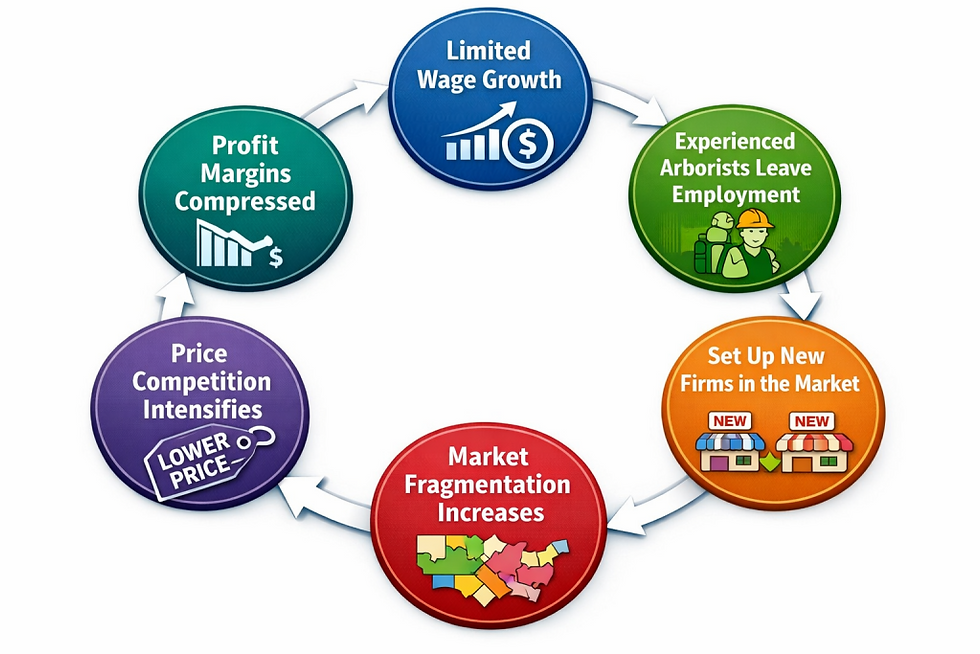
Labour supply responds to the terms of employment, and wages are one of the most visible terms. My research suggested that persistent arboricultural shortages warranted closer examination of wage-setting, particularly where firms benchmarked against one another without asking whether the resulting rate attracted and retained enough capable people.
An employer may genuinely be unable to raise wages substantially without increasing prices, changing its work mix, improving productivity or accepting lower margins. This does not remove the labour-market consequence. It means the workforce constraint is connected to the product market and the organisation’s commercial model.
A higher rate may compensate someone for longer hours, physical intensity or greater uncertainty, but it does not remove those conditions. Conversely, an organised and flexible employer cannot assume that positive culture will compensate indefinitely for remuneration that falls materially below the worker’s alternatives.
The relevant issue is the complete combination of compensation, work design, status, flexibility and future prospects required for the particular role to compete in its labour market. This combination will vary by location, capability level and employment segment. A utility crew leader, a residential climbing arborist and an experienced contractor considering permanent employment may assess the arrangement differently.
Advertised pay ranges can also weaken credibility when the upper figure depends on a collection of capabilities possessed by almost no realistic applicant. The employer may be technically willing to pay the top rate, but the candidate may suspect that it exists primarily to attract attention.
A narrower and more clearly explained range can sometimes communicate more than a larger one. It allows the candidate to understand which capability is being valued and how the employer will determine where they sit.
Treating “arborists” as one homogeneous candidate group can conceal the actual reasons a critical position remains unfilled. The company may be competitive for developing workers but unattractive to people capable of leading crews. It may pay well for climbing ability while providing little reward for the operational and interpersonal work involved in leadership.
The relevant comparison is not simply the advertised hourly rate. It is what the employee receives in exchange for the full set of demands, risks and responsibilities carried by the role.
Different capability profiles require different reasons to join
A trainee, a developing climber and an experienced person capable of leading a crew do not simply represent different points on one recruitment scale. They create different forms of organisational value and compare the role against different alternatives.
A trainee may be attracted by structured development, exposure to varied work and evidence that the employer can turn early effort into meaningful capability. Often, the immediate need is simply an employer willing to take a chance on them and provide an opportunity to prove their worth.
They also need useful work they can perform before their advanced technical output becomes substantial. A trainee who remains dependent for too long becomes expensive for the company and may struggle to see evidence of their own progress.
A developing climber may place greater emphasis on access to strong trainers, climbing opportunities and a crew able to support learning without allowing mistakes to produce unacceptable consequences. Their assessment of the company may depend heavily on who they will work beside rather than on the formal title of the role.
An experienced arborist may care more about technical standards, autonomy, equipment, work variety, physical sustainability and whether management protects them from avoidable operational friction. They may also value the competence of the people supporting them. Advanced climbing ability creates less value when the ground operation cannot keep pace or the crew must be supervised through every ordinary task.
Crew leadership adds another layer, but it should not be treated as completely separate from climbing or seniority. In many firms, the climber and crew leader are the same person. In others, leadership shifts according to the work being undertaken and the particular expertise required.
Someone carrying crew responsibility is likely to assess whether the company provides the information, authority and supporting capability required to deliver the outcomes for which they will be held accountable. A title without meaningful influence over crew composition, equipment, scheduling or customer expectations can make the role less attractive rather than more prestigious.
An experienced arborist considering self-employment may need evidence that employee status can still provide control, recognition, financial reward and professional standing without the administrative and commercial burden of operating a business.
The strongest recruitment proposition therefore begins with the specific capability the organisation needs, the productive value that capability would create and the alternatives available to people who possess it.
A general message about culture, teamwork and development is unlikely to answer the different questions these candidates are asking.
Recruitment claims must be supported by evidence
A company can communicate almost any employment promise. The difficulty is making the promise credible. Statements such as “excellent culture”, “great work–life balance”, “career progression” and “industry-leading equipment” provide little useful information because they lack a reference point. They also give candidates no reliable way to determine whether the statement describes normal practice.
Specific operating evidence is more persuasive. A company claiming flexibility might show how existing employees use alternative working arrangements and how crews are scheduled around them. A progression claim might be supported by examples of people who moved into crew leadership, estimating, training, consulting or mixed roles.
A claim about high technical standards might be reflected in the work accepted, the pruning practices used, the training provided and the authority experienced arborists hold over technical decisions.
Claims about well-equipped crews might identify which equipment is normally available, how replacement decisions are made and whether employees repeatedly find themselves compensating for missing machinery through additional physical work.
Employee accounts can provide useful evidence, although these should not be treated as automatically representative. Experiences can vary between branches, contracts, supervisors and crews. The employee selected for a recruitment video may have a genuinely positive experience while others occupy materially different versions of the same nominal role.
The employer must therefore examine whether the promise is true across the relevant part of the organisation, not merely whether an example can be found to support it.
This is particularly important for geographically distributed companies. A national employer may possess a strong brand and formal employee proposition while the actual work system differs substantially between depots, contracts or managers.
Recruitment communication that ignores this variation can attract people into a role that does not match what they were led to expect. This can create early turnover, distrust and a weaker employment reputation in the labour market from which the company must recruit again.
Successful attraction can move the constraint elsewhere
Recruitment should not be judged only by whether a vacancy is filled. Hiring more trainees may increase the number of people entering the organisation while placing greater pressure on the experienced employees responsible for supervising them.
Recruiting another skilled climber might not dramatically increase output if the company lacks a crew leader, truck, equipment or enough supporting staff to form an additional productive crew.
Promoting an experienced arborist into a commercial role may improve progression and strengthen customer communication while simultaneously reducing field capacity. Introducing flexible schedules may improve attraction and retention while increasing the difficulty of maintaining stable crews.
These are not arguments against recruitment or workforce improvement. They illustrate why an intervention must be considered within the complete operating system. The relevant outcome is not the number of people attracted, but the additional productive capability the organisation can create and sustain after those people arrive.
A company may recruit successfully but fail to convert the new employee into useful capacity because onboarding is weak, crew composition is unsuitable or management lacks time to support the role. It may attract an experienced arborist and then lose them because the advertised autonomy disappears once operational pressure increases. It may recruit several trainees but slow its productive crews so substantially that the company becomes less able to fund their development.
Recruitment therefore connects directly to selection, deployment, development, management capacity and retention. Improving the first stage without examining those that follow can move the visible problem rather than resolve it.
Communication belongs near the end
A strong role can remain difficult to recruit for if suitable people do not know it exists or cannot understand why it differs from their present employment. Clear communication can reduce uncertainty, reach people who are not actively searching and give candidates enough evidence to begin a serious conversation.
Before this communication is developed, the employer must identify the critical capability, understand the candidate’s labour-market alternatives, examine the real employment experience and determine which internal conditions strengthen or weaken the role. Where those conditions are unattractive, the work system must change.
The employer is then advertising an employment product that people might genuinely want and need to be made aware of.
A job advertisement can introduce the role. A careers page can provide more detailed evidence. Current employees can describe the experience, while direct conversations can explore whether the arrangement fits the individual candidate. These are useful implementation tools, but they remain the communication layer of the workforce system. They amplify differences that already exist.
When the internal role is weak, better communication may increase applications, but it also increases the number of people exposed to the weakness. When the role is strong, communication allows the organisation to convert genuine operating advantages into labour-market visibility.
The same principle applies at an occupational level. Industry efforts often concentrate on increasing awareness of arboriculture and persuading more people to consider it as a career. Awareness can help where capable candidates simply lack information, but promotion cannot compensate for an occupation that compares poorly with the alternatives available to them.
Where the work offers an attractive future, existing participants become part of the recruitment system. They speak positively about the occupation, encourage others to enter and provide visible examples of what years of development can lead to. Where the occupation remains physically punishing, poorly rewarded or uncertain, greater awareness may merely expose more people to reasons not to choose it.
The strongest recruitment message is therefore rarely invented by the person writing the advertisement. It is discovered by examining what the organisation does differently and whether those differences create real value for the people whose capability it needs.
The recruitment question begins inside the organisation
Arboriculture employers face real constraints in attracting experienced people. Advanced capability takes years to develop, workers may have several employment alternatives and the physical nature of the occupation limits the long-term supply of people willing and able to remain in field roles.
A better employment system will not instantly create experienced climbers or eliminate geographic, commercial and training limitations. It will influence whether the organisation is making effective use of the labour market available to it.
Before asking how to write a more persuasive advertisement, the employer should examine what the candidate would actually be joining. How well will their skilled time be used? What makes the role physically and commercially sustainable? What authority accompanies responsibility? Where can the position lead? Which promises are consistently true, and what evidence would allow an outsider to believe them?
An advertisement can only sell the employment product that exists. The work begins by creating a role that capable arborists would rationally choose, then making that choice visible and credible.
Comments