
The Crew Leader Bottleneck: Building Senior Field Leadership in Arboriculture

Arboriculture businesses may have enough arborists on the payroll and still lack the leadership capacity to deploy them effectively. Developing a genuine senior field role could improve productive capacity, career progression and the economics of experienced field work.
An arboriculture company can have enough technically capable people to populate six crews and still possess only four genuinely deployable crews. The missing capacity is not necessarily another climber or recently qualified arborist; it may be the two people who can be entrusted to lead the other crews without continually pulling an owner or operations manager back into the work.
This is an important distinction because headcount and productive capacity are not the same thing. A crew leader affects the work of several people simultaneously by interpreting the scope, organising people and equipment, dealing with customers or clients, developing less experienced workers and resolving the routine uncertainty that appears once work begins. A strong leader can increase the capability of the crew around them, while an underdeveloped one can turn an apparently staffed crew into a continuing management problem.
Seen this way, crew leadership is not simply the next rung above arborist. It can be one of the constraints that determines how many crews the business can actually deploy, how much uncertainty the field can absorb and how far an experienced arborist can progress without leaving production.
A key role and a bottleneck role
Armin Trost's work on key and bottleneck functions provides a useful distinction. A bottleneck function has substantial demand but is difficult to fill because suitable labour is scarce. A key function is important because differences in performance within it can make a substantial difference to organisational success. The same role can include both types of function.
Crew leadership appears to fit both descriptions in many arboriculture businesses. When I interviewed employers during my postgraduate research into New Zealand arboriculture, I repeatedly encountered a distinction between people who were technically trained and people who were sufficiently experienced to work independently, supervise others and be trusted with a crew. Employers were not simply looking for another person holding an arboriculture qualification. They often needed somebody who could arrive and operate with relatively little additional supervision.
This distinction matters particularly in arboriculture because much of the work cannot be fully planned from an office. A work specification can establish what should be achieved, what equipment should attend and what known risks need controlling, but it cannot prescribe every consequential decision that will arise once the job begins. Species, defects, access, weather, equipment, crew capability, customer expectations and the behaviour of the tree interact in combinations that continually require local judgement.
The crew leader therefore sits at a point where individual capability becomes organisational capacity. A strong leader can improve the performance of several people, help developing workers become useful faster while preventing routine uncertainty from travelling back up the chain and derailing the productive system. In other words, they can sort out most problems themselves without phoning it in. Someone who is technically competent but unable to perform those wider functions can have the opposite effect.
Scarcity changes the way the role is designed
The difficulty is that crews still need leaders even when ideal candidates are unavailable. A company facing a shortage of experienced arborists cannot simply leave the position empty, so people are sometimes placed into leadership because somebody has to do it rather than because they have developed the broader judgement the role requires.
Management then has to design around that limitation. Where confidence is low, instructions become more detailed, authority becomes narrower and more decisions require checking or approval. Problems that might otherwise be solved at crew level are escalated to an owner, supervisor or operations manager. The nominal crew leader may be accountable for the outcome while lacking meaningful control over many of the decisions that determine it. An example might be job cards that must specify individual branches over general pruning goals.
Over time this can become self-reinforcing. Limited capability encourages tighter control, while tighter control gives people fewer opportunities to practise consequential judgement. The resulting role may also become less attractive to experienced arborists who want greater autonomy and responsibility rather than simply more accountability.
There is a further problem if every person carrying the title is treated as though they perform essentially the same job. A newly appointed crew leader who has never previously supervised a crew and a ten-year veteran capable of running substantial parts of the operation may share a title while contributing very different forms of value. If the role architecture cannot recognise that difference, there is little room for field leadership itself to grow.
This mirrors a broader problem within arboriculture. Grouping everyone from recently qualified workers to highly experienced field practitioners under the same occupational label hides many of the capability differences employers actually care about.
Morgeson, Delaney-Klinger and Hemingway's research on role breadth and job performance is useful here. Their field study found that autonomy and job-related skill were associated with people defining their roles more broadly, while broader roles were in turn associated with stronger job performance. While the research does not claim that endlessly expanding a job is desirable, it does challenge the assumption that everyone carrying the same title should necessarily make the same narrow contribution.
If a business wants a genuinely senior field role, seniority has to change what the person is capable of understanding, deciding and influencing.
Technical performance is only part of the outcome
The difference becomes clearer when a crew appears to perform exceptionally well according to a narrow production measure.
Consider a fixed-price residential job expected to occupy most of a day. The crew is unusually capable, access is easier than expected or better machinery is available, and the work is completed by lunchtime. From a production perspective this is excellent, with the promised outcome being achieved using substantially fewer labour hours.
However, the advantage only has commercial value if the rest of the system can retain it. If the customer believed they were effectively purchasing a full day of labour and nobody prepared them for an early finish, the productivity gain can instead create disappointment. A crew might complete the work in half the expected time, only for the company to face an argument that the invoice should also be reduced. In the worst case, people have worked unusually hard or accepted unnecessary production pressure to create a surplus that the business subsequently gives away.
A field leader with broader commercial experience is more likely to anticipate this. They may establish at the beginning of the job that the crew is unusually well resourced that day, explain why the work may progress rapidly, or make sure the customer understands that the agreed price relates to completing the specified outcome rather than purchasing a set number of labour hours. The technical work has not changed, rather it is the leader's understanding of how production interacts with customer expectations and commercial value.
Similar examples appear throughout the working day. Finishing today's job slightly faster may be a poor decision if it leaves essential equipment unprepared for tomorrow. Maximising immediate output may be undesirable if a rare training opportunity is lost. A technically correct interpretation of a scope may still create unnecessary conflict if the crew leader does not understand what the client thought they had purchased.
A capable field leader therefore needs to understand more than the visible job in front of them. They need enough knowledge of the surrounding system to recognise where apparently sensible local decisions create costs elsewhere.
Specialisation can hide the consequences of decisions
Division of labour creates enormous productivity advantages. A dedicated salesperson can become better at selling, a scheduler can become better at coordinating work and a field arborist can concentrate on production. Difficulties arise when people understand their own function extremely well but have little visibility of what happens to their decisions after the handover.
A salesperson may create a commercially sensible quote with an accompanying work order which is unnecessarily difficult to schedule. The scheduler may fill every available hour while creating poor equipment sequences or unsuitable crew combinations. A field crew may beat its quoted hours while creating a customer problem. Each person can be performing well against the information and objectives visible from their own part of the system.
The handover between functions therefore deserves attention in its own right. One role makes a decision and somebody else inherits its consequences. Scopers hand accepted work to scheduling, scheduling hands a plan to production, and production ultimately hands an outcome to the customer, client, quality process or contract administrator. The same pattern occurs within a crew when an experienced worker decides what a trainee will do, thereby affecting both today's production and the capability available in the future.
Where these boundaries repeatedly create friction, it is worth asking whether each side properly understands the constraints faced by the other. The objective need not be to remove specialisation, but to give people enough visibility of the wider system that they can make better decisions within their own part of it.
Cross-training provides a useful model
There is a well-developed research literature around this problem in team settings. Marks, Sabella, Burke and Zaccaro's research into cross-training and team effectiveness found that cross-training helped teams develop stronger shared understandings of how members' roles interacted, which then supported coordination and performance. The work was conducted in simulated team environments rather than real job sites, so the results should not simply be transferred wholesale, but the mechanism is highly relevant to work where one person's decisions continually affect everyone around them.
The literature also gives us a useful way of thinking about how much exposure is actually required. The National Academies' review of cross-training research describes three progressively deeper forms. Positional clarification involves explaining what another role does and requires. Positional modelling adds observation or shadowing so that the person can see those requirements in practice. Positional rotation goes further by giving someone hands-on experience performing the other role.
Research by Cannon-Bowers, Salas, Blickensderfer and Bowers found positional rotation particularly useful in highly interdependent work, where team members benefited from greater knowledge of each other's positions.
This fits arboriculture particularly well because the objective does not need to be permanent role mixing. A crew leader does not necessarily need to become the scheduler, estimator or salesperson. They may benefit from understanding enough of those functions to appreciate the consequences their field decisions create.
Someone who has spent time trying to construct a workable schedule may begin viewing vehicle readiness, equipment faults, job overruns and staff availability differently. Someone who has participated in quoting or customer complaints may interpret a vague job description differently. The value comes from widening the frame within which normal field decisions are made.
Multiskilling can go further when the work justifies it
Sometimes broader understanding is enough. In other situations there is genuine productive value in giving someone the capability to perform part of another function.
Construction researchers have examined this through multiskilling. Burleson, Haas, Tucker and Stanley's study of multiskilled labour in construction questioned narrowly defined single-craft work because conventional craft divisions did not always align with construction sequence or make the best use of available skills. Their modelling suggested that alternative labour-utilisation strategies could improve project performance and reduce reliance on scarce specialist labour.
Haas, Rodriguez, Glover and Goodrum's later work on implementing a multiskilled workforce reached an especially relevant conclusion. Broader worker capability only creates its full value when planning, scheduling and workforce organisation are adapted to make use of it. Their research also identified higher worker income and employability as potential benefits alongside improved productivity and lower overall labour requirements.
Gomar, Haas and Morton's work on partially multiskilled construction workforces similarly emphasised the importance of allocation. A worker possessing several capabilities does not automatically make the system productive; those capabilities have to be matched intelligently to the work.
This distinction is useful for field leadership. Sometimes the purpose of wider exposure is primarily to improve judgement within the existing role, while in other cases the person may become genuinely capable of performing selected planning, scoping, machine-operation, training or commercial functions themselves.
The appropriate depth depends on what is constraining the business. More responsibility and more skills are not inherently better, but they become valuable when they remove friction, protect scarce capability or improve the decisions being made elsewhere in the system.
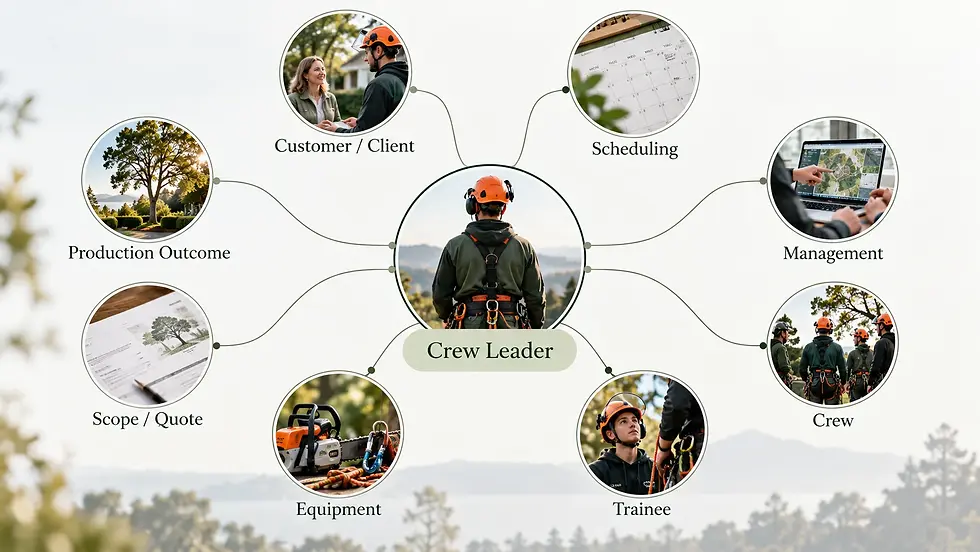
Crew leaders already span organisational boundaries
Crew leadership is particularly interesting because the position already sits across several organisational boundaries whether the company formally recognises this or not. The leader converts a quoted or scoped piece of work into production, represents the organisation to the customer or client, interprets management requirements, coordinates technical specialists and developing workers, and deals with information that cannot always be transmitted back to an office before a decision is required.
Organisational research describes activity that connects teams with people, information and resources outside their immediate boundary as boundary management or boundary spanning. Leicht-Deobald and colleagues' analysis examined 85 studies and found an overall positive relationship between boundary management and team performance, with particularly strong results for activities involving coordination, representation and information search.
An arboricultural crew is obviously not identical to every team represented in the literature, but the structural similarity is useful. The crew leader stands where planning meets execution, where the organisation meets the customer, and where management's intentions meet the unpredictable conditions of the field.
The purpose of cross-functional exposure is not to make everyone interchangeable. It is to let people see enough of the system to understand the consequences of their own decisions.
The better that person understands each side of those boundaries, the more uncertainty can potentially be resolved where the relevant information is actually available.
Crew leadership could become a genuine senior field career
This leads to a larger question about what an arboricultural career is meant to become. When I spoke with arborists and managers during my own research, career progression appeared repeatedly. Some participants suggested a "Master Arborist" type of position because people wanted somewhere to progress while remaining operational. The recognised pathway above field practice tended instead to point towards management, consultancy or self-employment.
A highly capable person needs somewhere to go. If the pathway is essentially trainee, arborist, better arborist and then leave the field, remaining operational eventually begins to resemble career stagnation. That is particularly perverse in an occupation where employers simultaneously complain about experienced capability disappearing from production.
An arborist should not have to leave field work in order to demonstrate that their career is still progressing.
Other technical occupations have faced similar problems. Douglas Hall's study of career plateauing in an engineering organisation examined a career structure that offered administration, technical specialisation and project management rather than assuming conventional management was the only form of advancement. The most interesting finding was that plateauing itself was not necessarily the central problem. Continued learning, use of accumulated skills, recognition and meaningful work all affected how people experienced their careers.
Arboriculture does not need to copy an engineering career structure. It does need a credible version of senior field employment. This might include greater technical authority, commercial understanding, operational planning, development of others, customer or client responsibility, selected cross-functional capability and progressively wider decision rights. The person can remain close to production while their value becomes progressively less dependent on how much material they personally cut, drag or chip.
This also changes the branches available later in the career. Someone who has developed only technical tree-work capability may face a sharp transition into quoting or management when they eventually leave the field. A senior field leader who has progressively gained experience across customers, economics, planning, workforce development and operational decision-making has a much broader base from which to move into operations, consulting, training, contract management, commercial work or general management if they eventually choose to do so. The field role can therefore be both a credible destination and a stronger platform for whatever comes next.
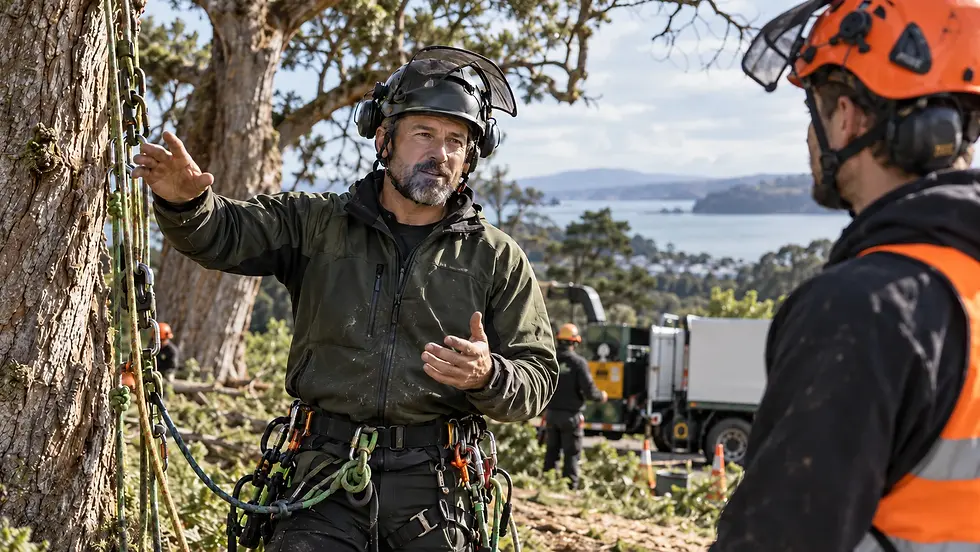
A senior arborist should look different
There is also an occupational-image question here. The public image of an arborist should not need to peak when a relatively young worker has recently become technically competent. There should be an obvious professional difference between that person and someone who has spent another decade accumulating judgement, understanding tree biology, observing reaction growth, solving difficult operational problems, managing customer expectations, developing other arborists with varied personalities and learning how tree work fits within a wider commercial or asset-management system.
At the senior end, the occupation can move closer to the image normally associated with a professional consultant without requiring the person to stop doing the work. The arborist who can explain tree physiology, discuss why a proposed intervention is appropriate, understand the customer's or asset owner's objective, evaluate the operational options and then participate directly in executing the work presents a different professional image from someone perceived primarily as a manual worker with a chainsaw.
Those capabilities do not need to be separated. Arboriculture has an unusual opportunity because sophisticated technical advice and physical execution can remain embodied in the same person. The practitioner explaining how a tree is likely to respond to pruning can also be the person making the cut and observing the result directly.
Senior field practice can therefore represent greater integration of knowledge, judgement and execution rather than eventual removal from practice. That has implications for the attractiveness of the career, the value employers can derive from experienced people and the way the occupation is perceived by customers and the wider public.
A broader role may also change the wage ceiling
Pay discussions in arboriculture quickly become difficult because employers operate under real product-market constraints. When I discussed wages with managers during my research, there was a recurring sense that field rates could only move so far before the economics of the existing role stopped supporting further increases. Simply arguing that arborists deserve more money does not resolve this constraint.
A broader senior role creates another route. If an experienced field leader increases the output of several other people, develops trainees faster, reduces customer problems, improves coordination with scheduling, protects equipment readiness, makes commercially sound decisions and removes ordinary management work from people higher in the organisation, their economic contribution is no longer represented by their own physical production. Instead, their value begins to sit in the productive system around them.
This does not mean adding a collection of management tasks to an already overloaded climber and calling the result progression, nor does broader responsibility automatically justify a particular rate of pay. The additional capability must create additional organisational value.
Where it does so, the employer has a much stronger economic basis for paying more. The construction multiskilling literature is interesting in this respect because it identifies higher worker income and employability alongside potential productivity and labour-utilisation benefits for employers. The mechanism is not generosity, rather the person becomes capable of creating or protecting more value.
Overly standardising the crew-leader role works directly against this possibility. If the same title, authority, expected contribution and pay structure must accommodate both someone taking their first steps into leadership and someone capable of independently running a substantial production unit, the organisation has already compressed away much of the seniority it might otherwise create.
This resembles the wider problem of describing a huge range of field capability simply as "arborist". The category becomes too broad to communicate much about the contribution being made. A better question is what progressively greater capability allows the organisation to entrust to the person, and what additional productive value becomes possible when it does.
Developing people who could leave
There is an obvious risk in broadening experienced employees this far. Someone who understands customers, quoting, scheduling, equipment, training, production and commercial decision-making is learning many of the capabilities required to run an arboriculture company.
That may appear dangerous in an industry where self-employment already competes strongly with employment, but withholding broader development does not remove self-employment as an option. It may instead make leaving the company the only realistic way an ambitious arborist can obtain greater autonomy, status, responsibility and control.
In my research, business ownership was one of the most common future destinations people imagined for themselves. That is not particularly surprising if the employed field role can reach a point where technical capability continues increasing while responsibility, status and earnings do not develop with it.
A stronger employment model would be willing to create people who could leave while making continued employment sufficiently valuable that leaving is not the only credible form of progression. Greater autonomy, broader responsibility, professional standing and meaningful development can all be provided within employment if the field role is designed to support them.
The opportunity is larger than leadership training
None of this suggests that every arboriculture company should immediately put its crew leaders through quoting, scheduling and management rotations. The appropriate design depends on the work, the people, the scale, existing capability, commercial model and constraints facing the organisation.
The good starting point is to understand the system surrounding the role. Where does information arrive from, which decisions are regularly escalated, what problems do the crew create for scheduling or management, what problems does planning create for the crew, and which responsibilities are experienced field leaders capable of absorbing if they receive the necessary information, exposure and authority?
Cross-training gives organisations different depths of exposure, from clarification through observation to actual rotation. Multiskilling provides a further option where there is productive value in someone acquiring additional capability rather than simply understanding another function. Boundary-management research helps explain why people positioned between functions can have disproportionate influence over how information and resources move through the organisation.
The resulting intervention need not resemble a generic leadership course. Its more likely to involve changing what people are exposed to, how work is handed between functions, what information is available at the point of action, how seniority is recognised and which decisions can be progressively moved towards capable people in the best position to make them well.
Conclusion
Arboriculture has spent a great deal of effort trying to produce more arborists or source them from overseas. So far, much less attention has been devoted to what the most experienced of those arborists should eventually become.
The crew-leader role sits at the centre of that question because it is already the point at which technical capability begins to multiply through other people and connect with the wider operating system. A highly developed crew leader can turn skilled labour into an independently functioning production unit, develop the next generation of arborists, protect commercial value, absorb routine uncertainty and reduce the amount of management attention required to keep work moving.
If the industry continues to define senior field work narrowly, standardise very different levels of capability into the same role and treat management or self-employment as the only meaningful progression, it should not be surprising when experienced people eventually leave production. That simultaneously removes some of the people the industry finds hardest to replace and limits the economic value employers can use to support better field remuneration.
There is another option. Senior field work can become broader, more autonomous, more commercially consequential and more demonstrably professional as capability develops. The experienced arborist can remain the person actually doing and leading the work while increasingly understanding customers, trees, people, production and the business system surrounding them.
The opportunity is therefore larger than training better crew leaders. It is to redesign the top end of the field arborist career so that greater experience continues to create greater responsibility, greater value and an occupational destination which is genuinely worthwhile.
References and further reading
Burleson, R. C., Haas, C. T., Tucker, R. L. and Stanley, A. (1998). Multiskilled Labor Utilization Strategies in Construction. Journal of Construction Engineering and Management, 124(6), 480-489.
Cannon-Bowers, J. A., Salas, E., Blickensderfer, E. and Bowers, C. A. (1998). The Impact of Cross-Training and Workload on Team Functioning: A Replication and Extension of Initial Findings. Human Factors, 40(1).
Gomar, J. E., Haas, C. T. and Morton, D. P. (2002). Assignment and Allocation Optimization of Partially Multiskilled Workforce. Journal of Construction Engineering and Management, 128(2), 103-109.
Haas, C. T., Rodriguez, A. M., Glover, R. and Goodrum, P. M. (2001). Implementing a Multiskilled Workforce. Construction Management and Economics, 19(6), 633-641.
Hall, D. T. (1985). Project Work as an Antidote to Career Plateauing in a Declining Engineering Organization. Human Resource Management, 24(3), 271-292.
Isaacs, J. (2021). Skill Mismatches and Worker Shortages in the New Zealand Arboriculture Industry. Master of Business Studies thesis, Massey University.
Leicht-Deobald, U., Backmann, J., de Vries, T. A., Weiss, M., Hohmann, S., Walter, F., van der Vegt, G. S. and Hoegl, M. (2025). A Contingency Framework for the Performance Consequences of Team Boundary Management: A Meta-Analysis of 30 Years of Research. Journal of Management, 51(2).
Marks, M. A., Sabella, M. J., Burke, C. S. and Zaccaro, S. J. (2002). The Impact of Cross-Training on Team Effectiveness. Journal of Applied Psychology, 87(1), 3-13.
Morgeson, F. P., Delaney-Klinger, K. and Hemingway, M. A. (2005). The Importance of Job Autonomy, Cognitive Ability, and Job-Related Skill for Predicting Role Breadth and Job Performance. Journal of Applied Psychology, 90(2), 399-406.
National Research Council (2015). Enhancing the Effectiveness of Team Science. National Academies Press.
Trost, A. (2014). Talent Relationship Management: Competitive Recruiting Strategies in Times of Talent Shortage. Management for Professionals.

Comments